Project Overview
The project I was allocated was a short 2D animated film titled The Cat and the Fish. The story follows a cat that steals a fish from a fisherman, gets caught, and is then given a second chance to work honestly. The film includes several dynamic animation sequences, particularly a scene where the cat runs through a busy market with complex camera angles. The final animation is planned to be around 3–4 minutes long, making it quite an ambitious project in terms of production and animation workload.
My Role in the Project
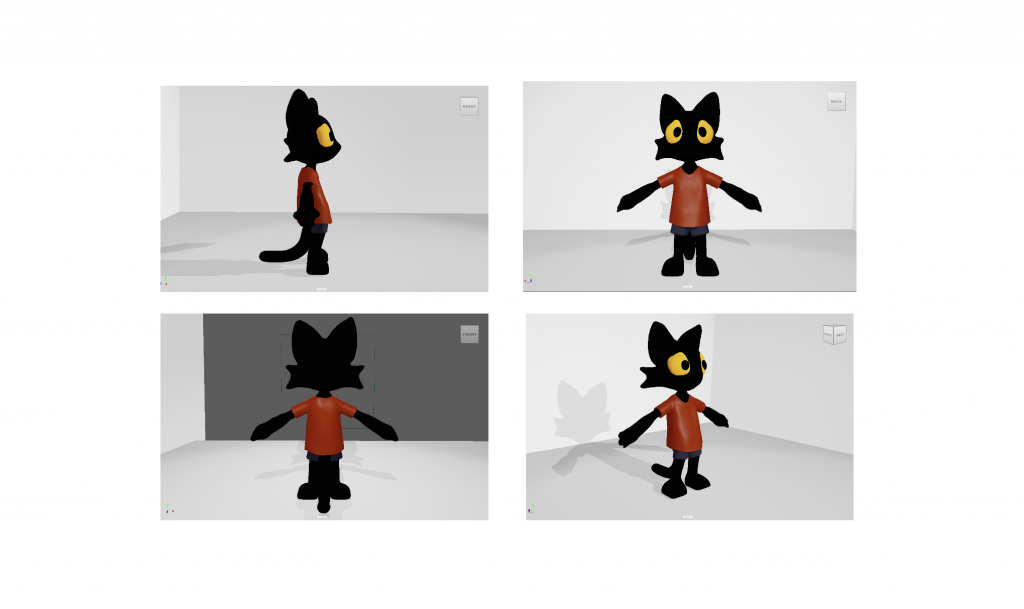
My main responsibility was to animate few 2D sequence from the film. In addition to this, I also worked on creating a 3D model of the cat character and developing a background environment for one of the market scenes. The purpose of the 3D model was to help visualise complex camera angles that would later be used as a reference while animating the 2D sequence.
The cat model also required basic rigging, allowing it to be posed correctly in scenes where the camera perspective was more complicated. This helped make the animation process easier when translating the 3D reference into 2D drawings.
Challenges and Learning a New Animation Style
At the beginning of the project, I was unsure about animating the sequence because the animation style used in the film was unfamiliar to me. However, I decided to treat this as an opportunity to learn something new. During this process, I explored the concept of snappy animation, where certain frames are held longer to emphasise impact while fewer in-between frames are used to maintain a sharp and energetic movement.
This style is commonly seen in anime productions such as Cowboy Bebop, where motion appears expressive despite having limited in-between frames. Although I am still adapting to this approach, practising it helped me understand how animation timing can significantly influence the feel of a scene.
Feedback and Improvements
During the project, I received technical feedback from the project head on one of my scenes. In this shot, the cat looks away from the fisherman while the fisherman reaches into his bag to take out a fishing rod. Initially, my animation lacked anticipation and arcs, which made the movement feel less engaging.
The senior suggested improving the shot by adding more storytelling beats. For example, the cat could briefly side-eye the fisherman, followed by a blink, before settling into a surprised expression. This helped create stronger anticipation and made the character’s reaction more believable. After applying these suggestions, the updated version of the animation felt more expressive and engaging. You can see figure 1 (Before) and figure 2 (After).
Figure 1
Figure 2
Another scene I worked on shows the cat attempting to steal the fish while the fisherman is cutting it. Although this shot has not yet received feedback, I plan to incorporate arc-based movement and anticipation when the fisherman turns his head toward the cat to make the motion feel more natural
(see figure 3).
Technical Development: 3D Modelling and Rigging
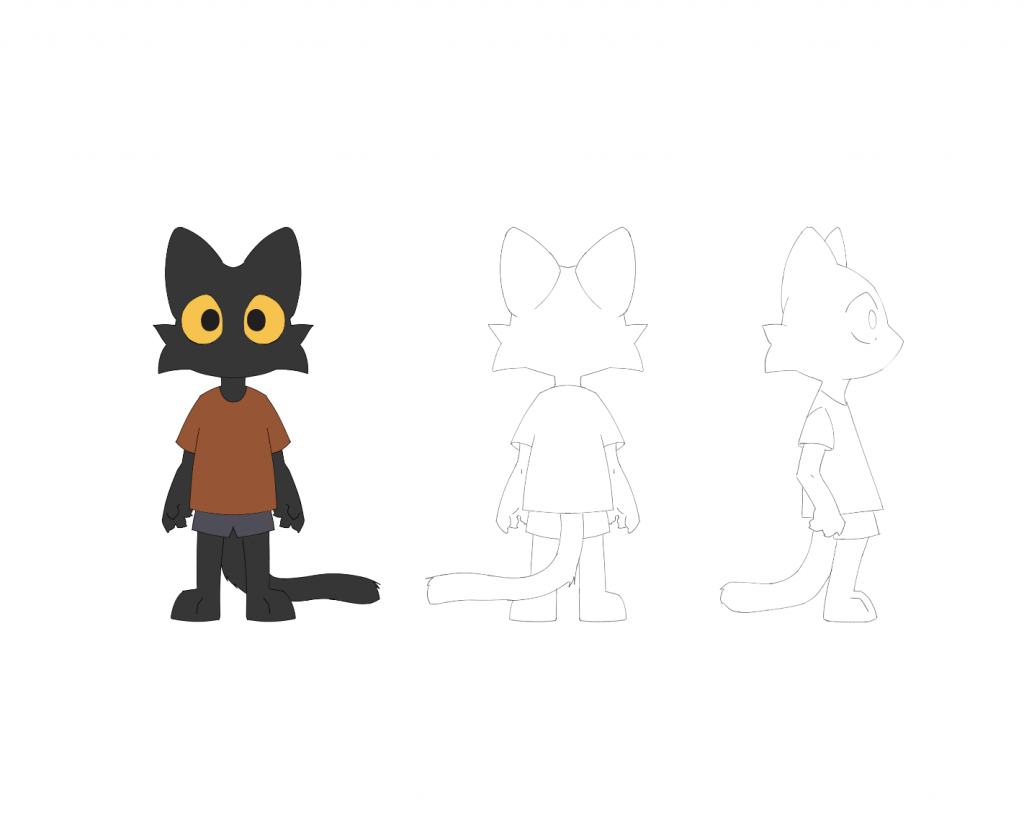
Alongside the animation work, I am currently working on rigging the 3D cat model. I received feedback suggesting adjustments to the eyes and moustache shape to better match the character turnaround design.
Working on the 3D model helped me understand how 3D tools can support a 2D animation pipeline, particularly when dealing with complex camera angles and perspective challenges. Here are some of the images of the 3D model from different angles for comparision with 2D turnaround
Understanding Timing Charts
Another important concept I learned during this project was the use of timing charts. Previously, I did not have a clear understanding of how they function in animation. Timing charts indicate the spacing between key poses and in-between frames, helping animators control acceleration and deceleration in movement.
Although the concept is easy to understand theoretically, applying it during animation requires planning key poses first and then estimating the spacing of the in-between frames. This process helped me better understand how timing and spacing influence the overall motion of a character.
Reflection on the Production Process
Overall, this experience helped me understand how a larger animation project is organised and managed. Tasks are divided among team members, and progress is tracked using production tools that help manage deadlines and responsibilities.
Through this project, I was able to improve my animation techniques, technical skills in 3D modelling and rigging, and understanding of professional animation workflows. It also gave me valuable insight into how collaborative animation production works in a professional environment.
Learning Resources
During this project, I also referred to several online tutorials to better understand animation techniques such as timing, in-betweening, and character movement. These videos helped me improve my understanding of animation fundamentals and apply them during my work.
Choppy Animation / Snappy Animation
https://youtu.be/BBoVomEOKbc
Understanding Timing Charts
https://youtu.be/uZQ4GCdiCuM
Timing Charts and Inbetweening
https://youtu.be/86tqKH3zxuM
Character Walks by James Baxter
https://youtu.be/vihIPBrP6y0
Overshooting and Impact in Animation
https://youtu.be/wNJUMSJ2-qA
